
Sub-Total: £0.00

Is Sugar-Free Chocolate Actually Good For You?
First published 07 Apr 2024|Last Updated 08 Jun 2026
7 Science-Backed Health Benefits (And One Honest Catch)
Updated June 2026 · 6 min read · Reviewed against peer-reviewed research
Key Takeaways
- Real cocoa is genuinely good for you. The trouble is most chocolate bars drown it in sugar and milk powder.
- Properly made sugar-free chocolate keeps almost every health benefit of dark chocolate, without the sugar crash.
- The sweetener that replaces the sugar matters more than the word “sugar-free” on the wrapper.
- Yacon syrup is the gold standard. It has a glycaemic index under 5 and feeds your gut bacteria.
- Maltitol and sorbitol are the troublemakers. They can spike your blood sugar AND upset your stomach. Avoid them.
- If a chocolate bar shouts “sugar-free!” on the front, flip it over. The ingredients list is where the truth lives.
The honest answer first
Yes, sugar-free chocolate can be properly good for you. But only if it is made properly. Some of it absolutely is. Some of it is a marketing trick wearing a lab coat. The next 6 minutes will help you tell the difference, without you needing a chemistry degree.
The short story is this. Chocolate’s health benefits come from cocoa, not sugar. So when you take the sugar out and keep the cocoa in (especially raw cocoa), you keep almost all of the good stuff. The catch is that whatever the manufacturer puts IN to replace the sugar can either help you, do nothing, or genuinely upset you. We will tell you which is which.
If you fancy a deeper dive into the sweetener side of things, our guide to the hidden dangers of sugar alcohols is a good companion read.
Curious to taste the principles? Mr Popple’s sugar free chocolate is built on raw cocoa, yacon syrup or coconut sugar – never erythritol, maltitol or any sugar alcohols or artificial sweeteners.
Here are the seven benefits worth knowing about.
1. It is properly good for your heart

Dark chocolate has been studied for heart health more times than is probably reasonable. The bit doing the work is called flavanols, and they live in raw cocoa.
A real-world trial at the University of Surrey found that cocoa flavanols lowered arterial stiffness and blood pressure in healthy adults. Harvard Medical School has also linked cocoa to less of the inflammation behind heart disease in the first place.
Here is the clever bit: sugar is not doing any of that work. The flavanols are. So if you remove the sugar, the benefits stay. If you leave the sugar in, you actually undo some of those benefits, because sugar makes inflammation worse. So sugar-free, in this case, is not just neutral. It is an upgrade.
One catch worth knowing
Flavanols hate heat. Heavily roasted or “Dutch-processed” cocoa loses most of them. Look for raw chocolate or minimally processed cocoa on the label. If it does not say either, assume the worst.
2. No more 4pm energy crash
You know that mid-afternoon feeling where your brain turns into porridge and you would happily nap on a filing cabinet? That is a sugar crash. It is not your fault. It is chemistry.
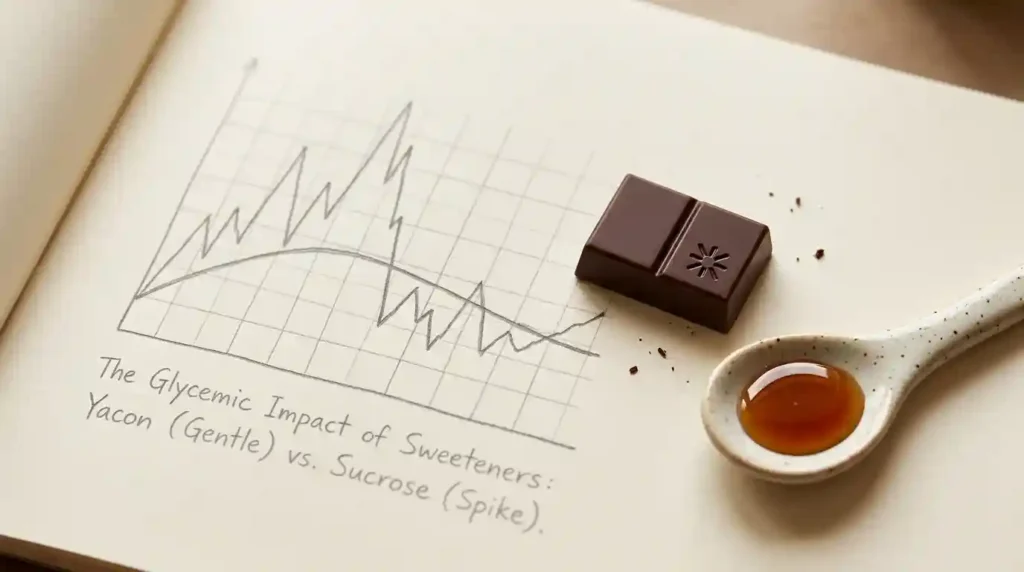
Refined sugar shoots your blood glucose up like a firework, then drops it like a stone. Cue: hangry, sleepy, snacky. Swap the sugar for a low-glycaemic sweetener and that rollercoaster flattens out into something more like a gentle bus journey.
Yacon syrup barely registers on the scale (GI under 5). Coconut sugar sits around GI 35, which is roughly half the impact of regular sugar. Either is a serious step up from the white stuff. The difference is not just feeling steadier through the afternoon. It is not being ambushed by cravings two hours later, which is honestly half the battle.
3. Your brain quite likes it too
Cocoa contains compounds that prompt the release of endorphins (the “I feel pretty good actually” chemicals), plus a thing called theobromine. Theobromine is basically caffeine’s calmer, friendlier cousin.
A 2017 paper in Frontiers in Nutrition with the magnificently nerdy title Enhancing Human Cognition with Cocoa Flavonoids pulled together evidence that cocoa flavanols improve attention, memory, and how quickly your brain processes things. Studies on healthy young people even show that flavanol-rich cocoa increases blood flow to the brain regions involved in thinking.
None of that requires sugar. So when you take the sugar out, the smart bit stays. You do not suddenly get dimmer just because you skipped the refined stuff.

4. A real win if you watch your blood sugar
If you are tracking your glucose, whether for diabetes, PCOS, sport, or just general curiosity, the choice of sweetener is basically the whole game.
A randomised clinical trial published on PubMed ScienceDirect found that yacon syrup actually reduced the blood sugar spike people normally get from breakfast, compared with a control group. That is a measurable, statistically significant result. It is not a brand making a vague promise on a banner.

A quick honest note here. We are a chocolate company, not your doctor. If you have diabetes, please talk to your GP before changing what you eat. Even if it is our chocolate.
5. Antioxidants that actually do something
You have heard “antioxidants” thrown around so often it has nearly lost all meaning. So here is the actual job description. Antioxidants neutralise free radicals, which are unstable little molecules that damage your cells and are linked to long-term inflammation.
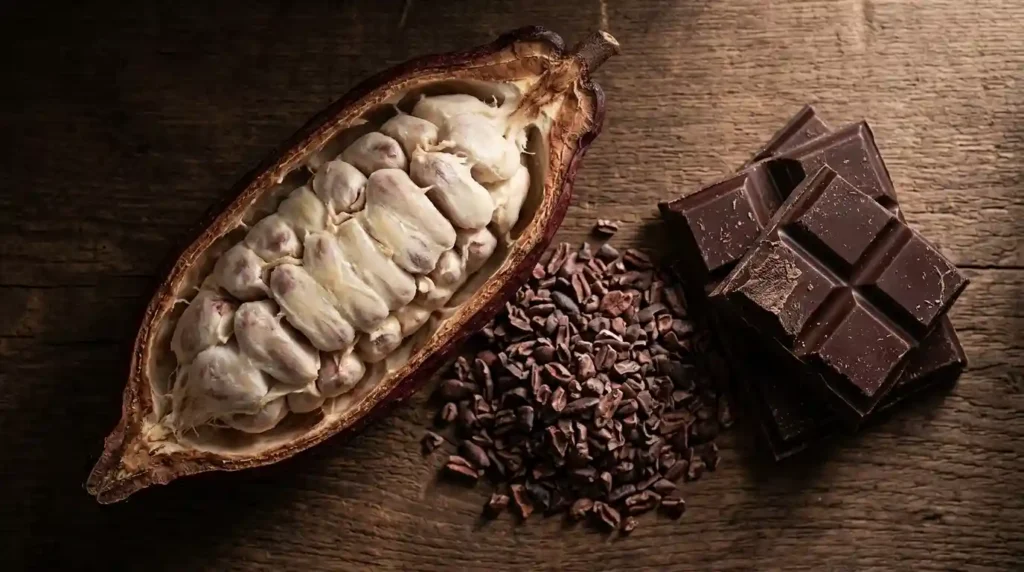
Cocoa is one of the most antioxidant-dense foods on the planet. Higher per gram than blueberries. Higher than green tea. The catch is awkward for most chocolate bars though. Most milk chocolate is only 20 to 30% cocoa. The rest is sugar and milk solids. So you are getting a small, watered-down dose of the good stuff, drowned in not-so-good stuff. A bar at 70% or higher with no refined sugar is, gram for gram, a completely different food.
This is also why our dark chocolate bars are built on the same high-cocoa principle. No filler. Just chocolate that earns its place in your day.
6. Your gut bacteria might actually thank you
Stay with us, this one is genuinely cool.
Yacon syrup is naturally rich in inulin and fructo-oligosaccharides. (That is the most fun word in this article, please say it out loud.) These are prebiotic fibres. They feed the friendly bacteria in your gut, particularly the bifidobacteria that a Healthline review explains in proper detail.
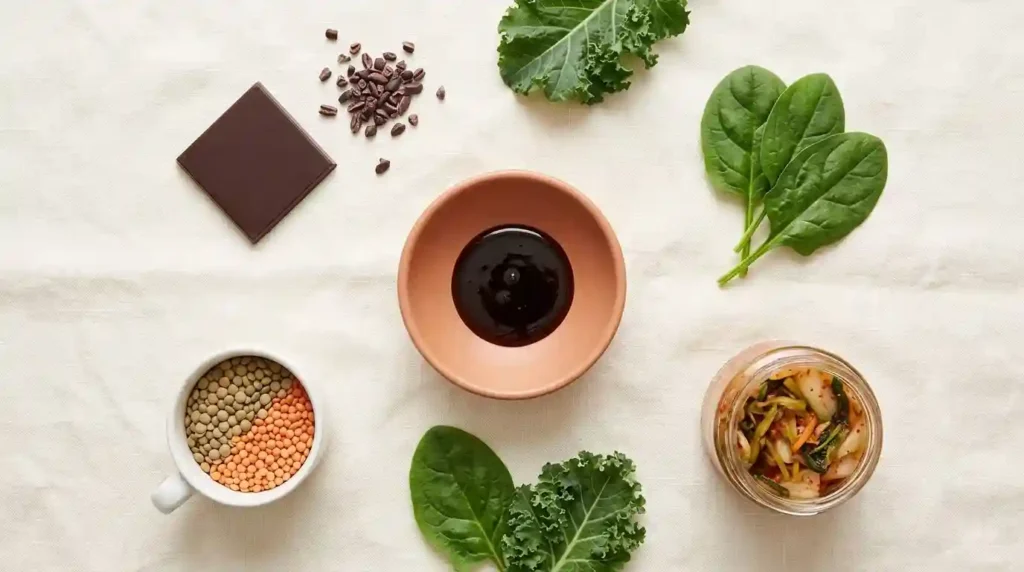
A happy gut is connected to better digestion, a stronger immune system, and even your mood. Yes, really. Your gut talks to your brain through something called the gut-brain axis. It sounds made up. It is not.
This is the one benefit that is genuinely added by the sweetener, rather than just preserved. We have heard from a long-time customer who has Candida and finds yacon-sweetened bars are the only chocolate she can eat without flaring up. That is one person, not a clinical trial. But it lines up neatly with what you would expect from the prebiotic effect, which is interesting.
7. The cheat code: sustainable indulgence
This is the least scientific point and quite possibly the most important.
Restrictive diets fail. Almost all of them, almost all of the time. The reason is boringly human. Nobody wants to live without small daily pleasures. A daily square of chocolate that you actually enjoy beats a month of cabbage soup followed by a Friday-night biscuit binge. Every time.
If sugar-free chocolate is the thing that lets you keep chocolate in your life rather than swearing it off entirely, that is not a small win. That is possibly the whole point.
If you want to make it even easier, our chocolate subscription box drops your choice of bars through your letterbox each month. So your daily square sorts itself out without you having to think about it.
What “sugar-free” should actually mean
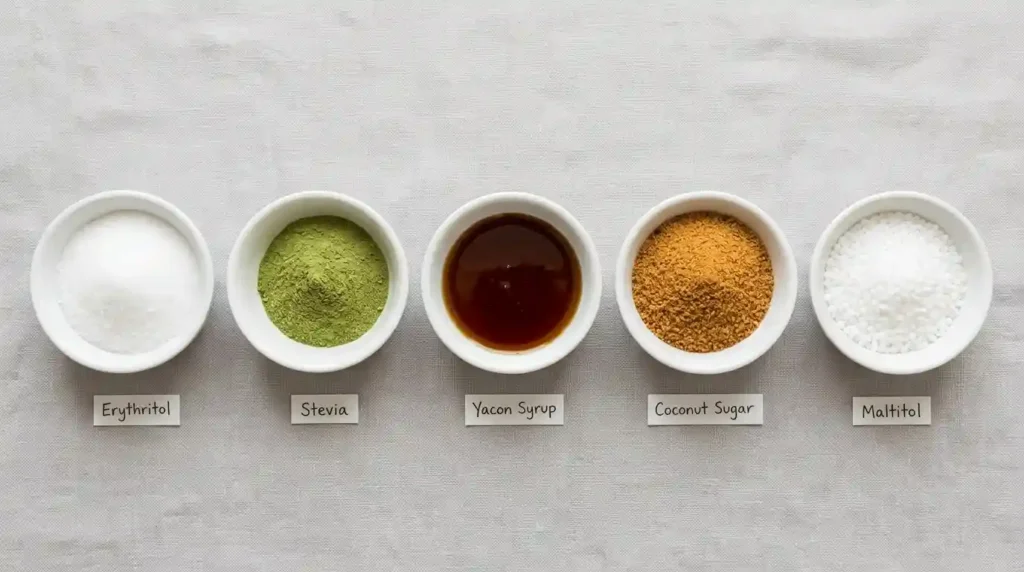
Not all sugar-free chocolate is created equal, and some of it is genuinely a bit dodgy. Here is the cheat sheet.
| Sweetener | Glycaemic Impact | Common Side Effects | Verdict |
|---|---|---|---|
| Maltitol / sorbitol | Moderate to high | Bloating, urgent toilet trips | Avoid |
| Erythritol | Near-zero | Mild for most people | Acceptable |
| Stevia | Zero | Slight aftertaste | Acceptable |
| Yacon syrup | GI under 5 | Prebiotic (a good thing) | Best in class |
| Coconut sugar | Around GI 35 | None notable | Reduced sugar, not truly sugar-free |
If a bar shouts “sugar-free!” on the front and lists maltitol on the back, put it back on the shelf. Your stomach will write you a thank-you card later.
The bottom line
Sugar-free chocolate done properly (high cocoa, naturally sweetened, minimally processed) keeps almost every documented benefit of dark chocolate, while losing the metabolic baggage of refined sugar. The “done properly” part is doing a lot of work in that sentence.
So here is the rule of thumb to take away. Read the back of the wrapper, not the front. The marketing department wrote the front. The legal department wrote the back. Trust the legal department. Look for raw cocoa. Look for yacon syrup, stevia, or coconut sugar (knowing coconut sugar is a halfway house, not a true sugar-free option). Avoid maltitol and sorbitol like they owe you money.
If you want to taste what we are on about, Mr Popple’s full range of sugar free chocolate is built on exactly the principles in this article. Raw cocoa, yacon syrup or coconut sugar, no refined sugar, no maltitol, no compromises.
Ready to taste what we’re on about?
Mr Popple’s full range of sugar free chocolate is built on the principles you’ve just read about. Raw cocoa, yacon syrup or coconut sugar, no refined sugar, no maltitol, no nonsense.
Free UK delivery on orders over £25 · Plastic-free packaging

Frequently Asked Questions
Is sugar-free chocolate actually healthy, or is that just clever marketing?
Both exist. High-cocoa bars sweetened with yacon or stevia keep cocoa’s real benefits without the sugar downside. Low-cocoa bars sweetened with maltitol are a different conversation, and not one your stomach will enjoy. Read the ingredients, not the front of the wrapper.
Can sugar-free chocolate spike my blood sugar?
Properly made, no. Yacon (GI under 5) and stevia (zero) barely register. Coconut sugar gives a mild bump (about half the effect of regular sugar). Maltitol bars CAN spike glucose despite the “sugar-free” label, which is a bit cheeky of them really.
Is sugar-free chocolate safe for diabetics?
We cannot give medical advice. The evidence on yacon syrup specifically is genuinely encouraging, but always check with your GP first. We would rather you be sure than sorry.
Will sugar-free chocolate upset my stomach?
Some types absolutely will. Sugar alcohols (especially maltitol and sorbitol) are usually the culprits. Yacon, stevia, and coconut sugar do not typically cause this kind of trouble.
What is the difference between yacon syrup and coconut sugar?
Yacon is barely a sugar at all. Nutritionally it behaves more like a fibre, with a glycaemic index under 5. Coconut sugar is genuinely a sugar, just a kinder one (GI around 35). So bars sweetened with coconut sugar are not strictly “sugar-free”, but they are a noticeable step down from regular sugar.
Is sugar-free chocolate vegan?
Mr Popple’s range is fully plant-based. Other brands vary, so check the label for milk solids and whey if that matters to you.
Can I bake with sugar-free chocolate?
Yes, happily. Yacon-sweetened dark chocolate behaves much like a standard 70% bar in baking, just with slightly less sweetness. So if you are making brownies, you might want a touch of extra natural sweetener in the mix.
How should I store sugar-free chocolate?
Cool, dry, and away from direct sunlight. A kitchen cupboard is fine. The fridge is unnecessary unless your kitchen is a sauna, in which case sort that out first..
References
- Cocoa shown to reduce blood pressure and arterial stiffness in first real-life study – University of Surrey
- Cocoa reduces inflammation associated with heart disease – Harvard Medical School.
- Cerebral blood flow response to flavanol-rich cocoa in healthy elderly humans – National Library of Medicine
- “Enhancing Human Cognition with Cocoa Flavonoids” Frontiers in Nutrition in 2017
- Is Coconut Sugar a Nutritious Replacement? www.verywellhealth.com
- Free radicals, natural antioxidants, and their reaction mechanisms – The Royal Society of Chemistry
- Inulin prebiotic: is it all about bifidobacteria? – BMJ Journals (gut.bmj.com)
- Yacon syrup reduces postprandial glycemic response to breakfast: A randomized, crossover, double-blind clinical trial – ScienceDirect.com
- Effect of cocoa on blood pressure – Pubmed (pubmed.ncbi.nlm.nih.gov)